The Privateer
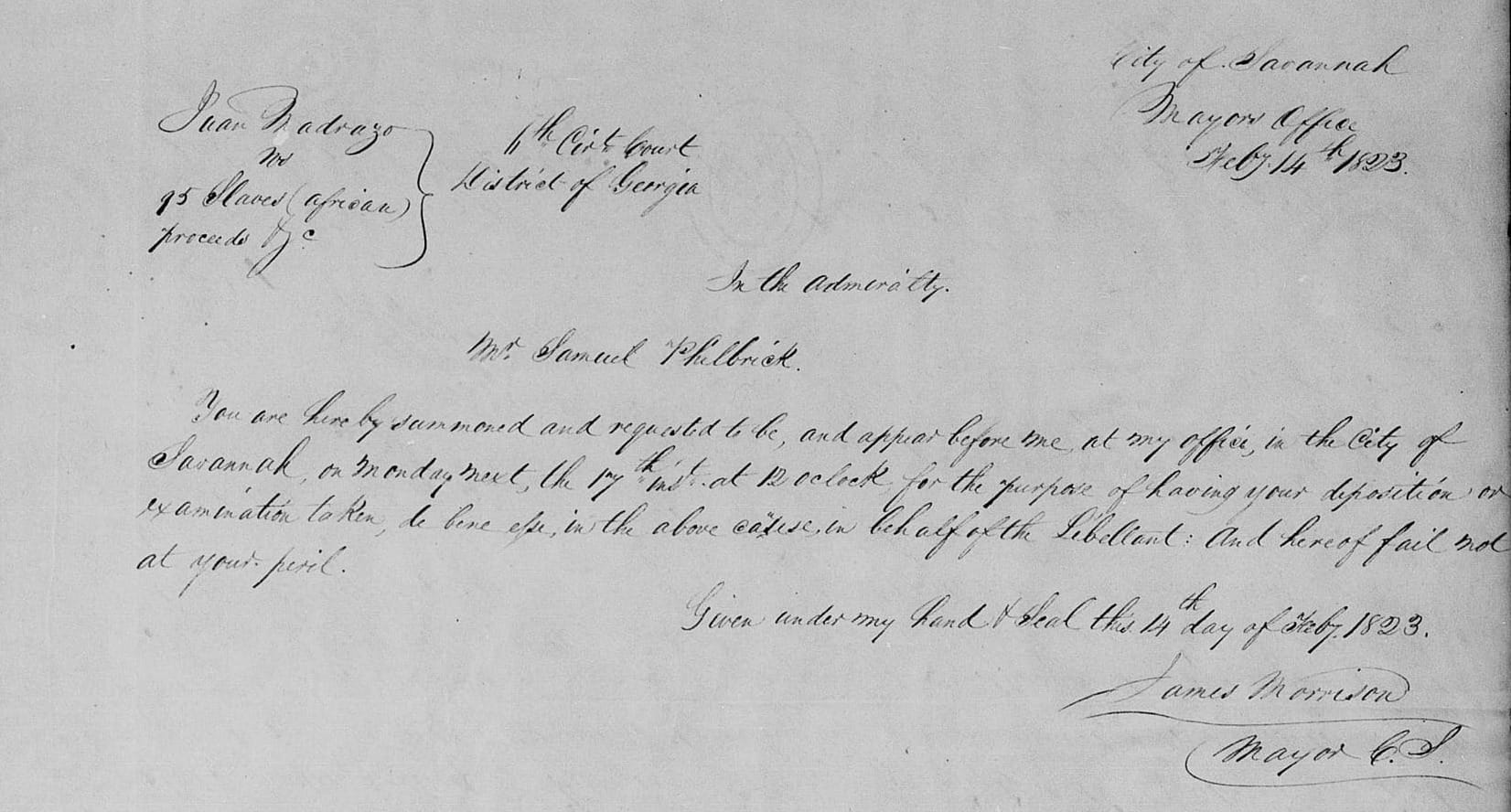
On Saturday, February 22, 1823, a little past noon, a man walked into the mayor's office of the City of Savannah to swear out the story of a crime he had helped commit.
On Saturday, February 22, 1823, a little past noon, a man walked into the mayor's office of the City of Savannah to swear out the story of a crime he had helped commit.
The paperwork survives, and it is fussy in the way only admiralty paperwork can be. A summons had gone out on the 14th ordering one Samuel Philbrick to appear the following Monday. "And hereof fail not at your peril," the summons warned. The examination was then postponed to Saturday. The mayor, James Morrison, took the deposition down in his own handwriting, as the act of Congress required, because the witness could not be produced at trial: Samuel Philbrick, "at present" of the City of Savannah, "aged thirty years and upwards," was—the phrase recurs through the file like a drumbeat—"about to proceed beyond the limits of the United States." He was bound, per the petition, for Jamaica. The clerk recorded his birthplace as "Durfield," New Hampshire, which is how Deerfield sounds when a Yankee says it to a Georgian with a quill.
The man who wanted this testimony taken down was Juan Madrazo, a Spanish subject of Havana, a slave trader in the years when Spain still permitted it, and the owner of a vessel called the Isabelita. He was suing to recover stolen property. His property was, or had been, 110 human beings.
The witness he needed—the man whose account a federal judge would later call "so full clear & explicit as to preclude the necessity of resorting to any other"—was the privateer who had taken them from him.
This installment is about that man, that ship, and those 110 people: a story in which everyone sues everyone, every court weighs in, the words slave trade appear on nearly every page, and not one of the 110 ever becomes anything, in the law's eyes, but cargo. The lawsuits are about the proceeds, which is to say, the money to be made from property.
A man who wished to be forgotten
Samuel Philbrick was born in Deerfield, New Hampshire, on February 7, 1793, the son of a trader and tavern-keeper. The family's own genealogy, published in 1886, says he "went to Georgia in 1819 as a teacher." The paper trail says something very different, and what it says instead is the story of how the early republic actually staffed its wars—official and otherwise.
Around 1814 he turns up as a private in James Forrest's Maryland militia company, a service known from the pension card his widow filed on decades later. By October 1815, with the War of 1812 over, he is in Baltimore, out of work, living on the charity of a benefactor, and writing home to his uncle in Deerfield with a request: "say not a word of me to anyone - I wish to be forgotten by all except a few dear friends."
Baltimore in 1815 was a bad place to be an unemployed veteran and a spectacular place to be a young man willing to break a few laws. The city's shipyards had spent the war building the fastest schooners afloat, and with the peace, that fleet and its sailors rolled straight into a new business: privateering for the South American republics then in revolt against Spain. The commissions were foreign, the investors and crews were American, and the whole arrangement ran on a wink, because U.S. neutrality law forbade nearly all of it. With in a year, the man who wished to be forgotten found the trade that asks no questions about who you were.
The commissions themselves, the legal fig leaf of the whole business, were for sale in Baltimore like any other stationery. A record printed for the Supreme Court tells how, in May 1816, the schooner Orb cleared the port as a merchantman, took her crew and her muskets aboard by night in the stream below the city, and became, once safely at sea, the Buenos Ayrean privateer Congresso. Her commission was counterfeit: the local agent of one Commodore Taylor, who sold genuine Buenos Aires commissions at a tenth of all prizes taken under them, had run out of stock, so a Baltimore silversmith cut a copy of the seal—and "all the requisite signatures were executed in Baltimore, by a certain Samuel Philbrick."
Thus began the privateering career of the man who would soon draw a lot in the 1821 Georgia land lottery. Within a year, Philbrick graduated from forging signatures to leading boarding parties on privateer ships running the exact same shell game.
A ship with two names
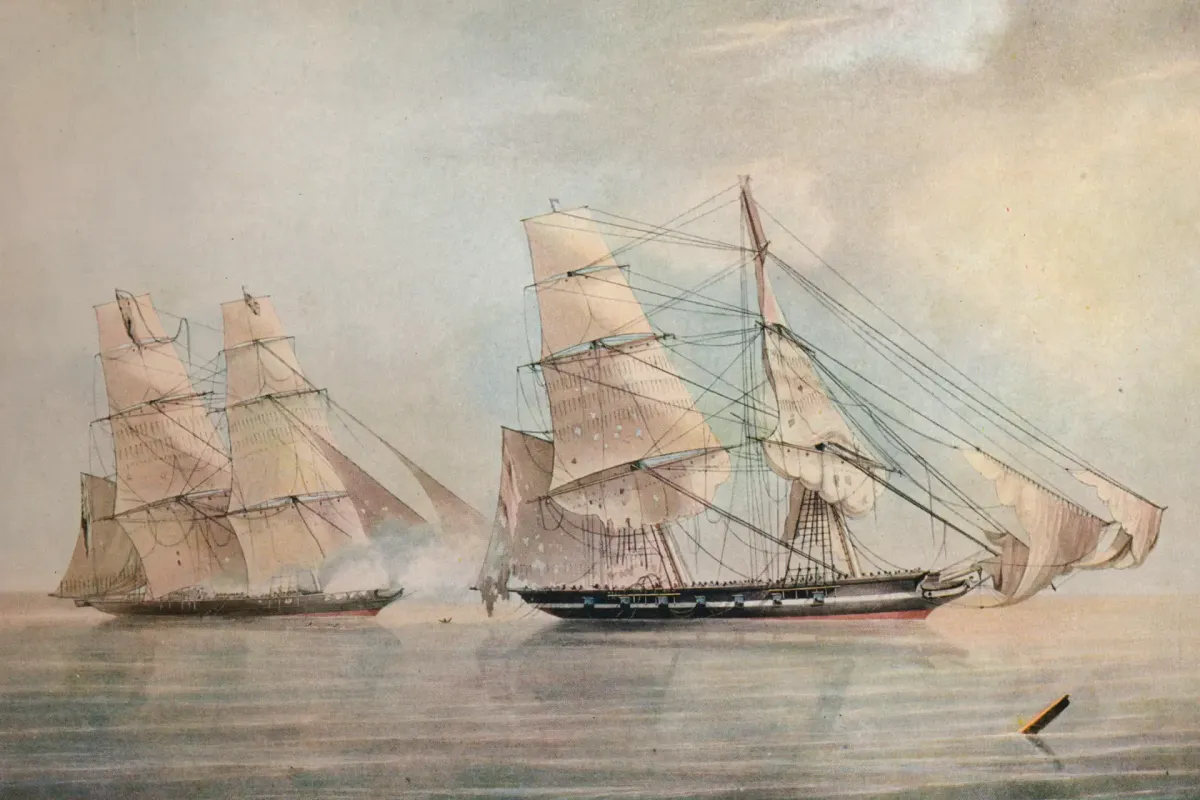
A vessel called the Foren Espartan cleared Baltimore in 1817, her declared destination Curaçao. The cruise that follows is substantially as Philbrick himself swore it in 1823. The destination was fiction; she was bound for Fernandina, on Amelia Island, at the top of Spanish Florida. She took on her armament not in port but "in the waters of the Chesapeak"—the maritime equivalent of loading the getaway car around the corner. Her commander, William Moore, was an American with a wife and family in Baltimore. At Amelia Island she hoisted the flag of Louis-Michel Aury, the French corsair then running Fernandina as a privateer republic, reshipped the same Baltimore crew under a new name, and became the Successor. Same hull, same men, new paperwork, because property is just a thing you do with documents.
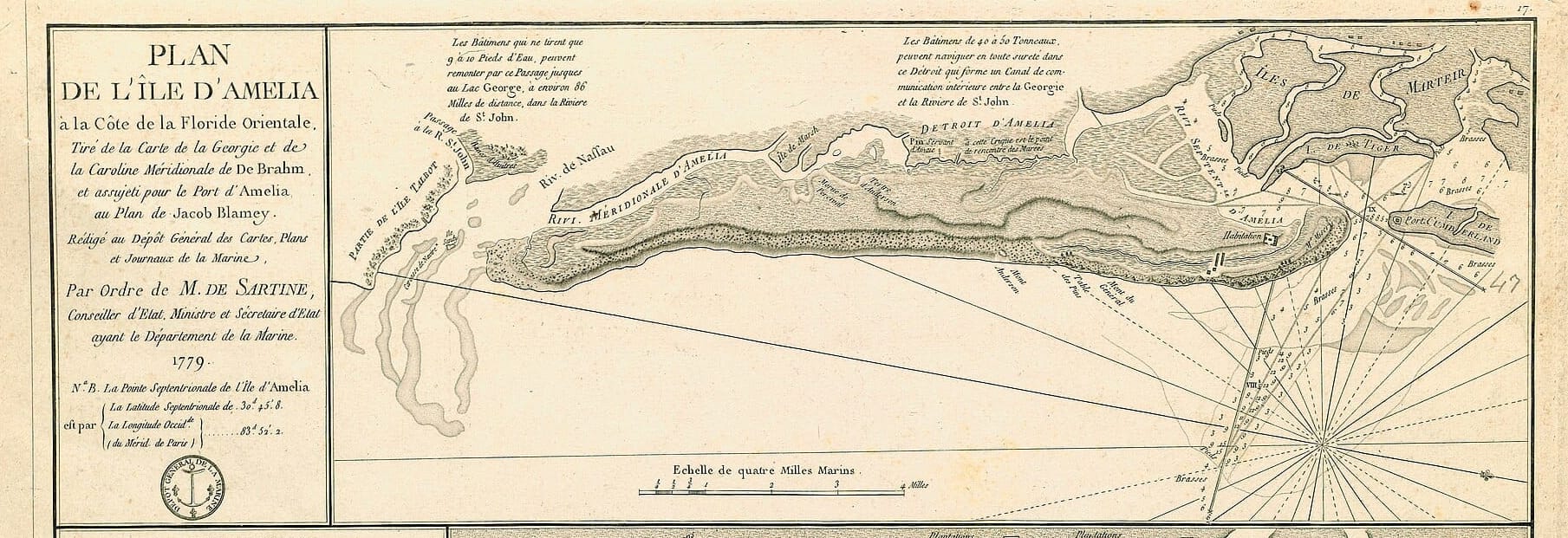
The Successor sailed from Fernandina about the first of October, 1817, "on a cruise against the subjects and commerce of Spain," with one pivot gun, eleven smaller pieces, thirty-odd men with swords, pistols, and muskets. Her Captain of Marines—the officer commanding the boarding party, the men whose job begins where the cannon fire stops—was Samuel Philbrick, aged twenty-four.
In sight of Nassau she took the Isabelita, a Spanish slaver either coming from or going to Havana, "having on board a cargo consisting of slaves and Ivory—the number of slaves one hundred and ten."
One hundred and ten is Philbrick's sworn count, given twice in the deposition: aboard at capture, and delivered afterward. The 1823 decree in the same case says 112 taken and 110 sold. The case caption itself reads 95—the number later seized by a customs officer on the road to Alabama, by the count that reached the Supreme Court. The numbers shrink at every station of the story, and each drop is people the paperwork stopped counting.
By October 17 the Successor had carried her prize into Fernandina, where a tribunal "sustaining Admiralty Jurisdiction under the authority of Commodore Aury"—a prize court of the captor's own government, in the captor's own port, under the captor's own flag—condemned ship and cargo. An agent for the privateer, Louis Segallis, sold the 110 people to two buyers: Augustus Balles, and a Georgia man named William Bowen.
Legally, all of this happened outside the United States. That was the entire point of Amelia Island. The U.S. had banned the importation of enslaved people in 1808; Spain's Florida began at the St. Marys River; and so a captured slave ship brought into Fernandina was, on paper, none of Washington's business—until her cargo crossed the river. Amelia Island in 1817 was a duty-free shop for the one commodity American law had renounced, sitting an hour's sail from the American coast, and everyone from Savannah to the White House knew it. In December 1817, two months after the Isabelita came in, President Monroe sent troops to shut Aury's establishment down, citing, among other things, its traffic in "slaves from Africa."
By then, William Bowen and the people he had purchased were already gone—northwest, overland, into the United States.
From cession to smuggling
In the first installment of this series, on the signature page of the treaty that made the land around Cop City ownable, I asked you to keep a name in mind: D. B. Mitchell, ex-governor of Georgia, federal agent to the Creek Nation, witness to the cession.
William Bowen's smuggling route ran through the Creek Agency—Mitchell's agency, the federal compound on the Flint River that existed to manage the border between the Muscogee Nation and the state, in the years before the First Treaty of Indian Springs signed over the land to the east. You could hardly design a better smuggling corridor: "Indian country" was outside state jurisdiction, thinly patrolled, and administered by exactly one federal officer, who in this case was happy to welcome the smuggled Africans and pretend he'd never seen them.
The Isabelita's captives were marched from Amelia Island up into Mitchell's agency and held there. Colonel Richard Dennis, a Savannah merchant with his own privateering interests, testified that it was "notorious" that Bowen had taken seventy of them in. Attorney General William Wirt investigated; his report on Mitchell and the "smuggling of African Negroes" ended Mitchell's federal career in 1821. Being caught facilitating the African slave trade, three decades after the Constitution's authors blushed to name it, cost him a job.
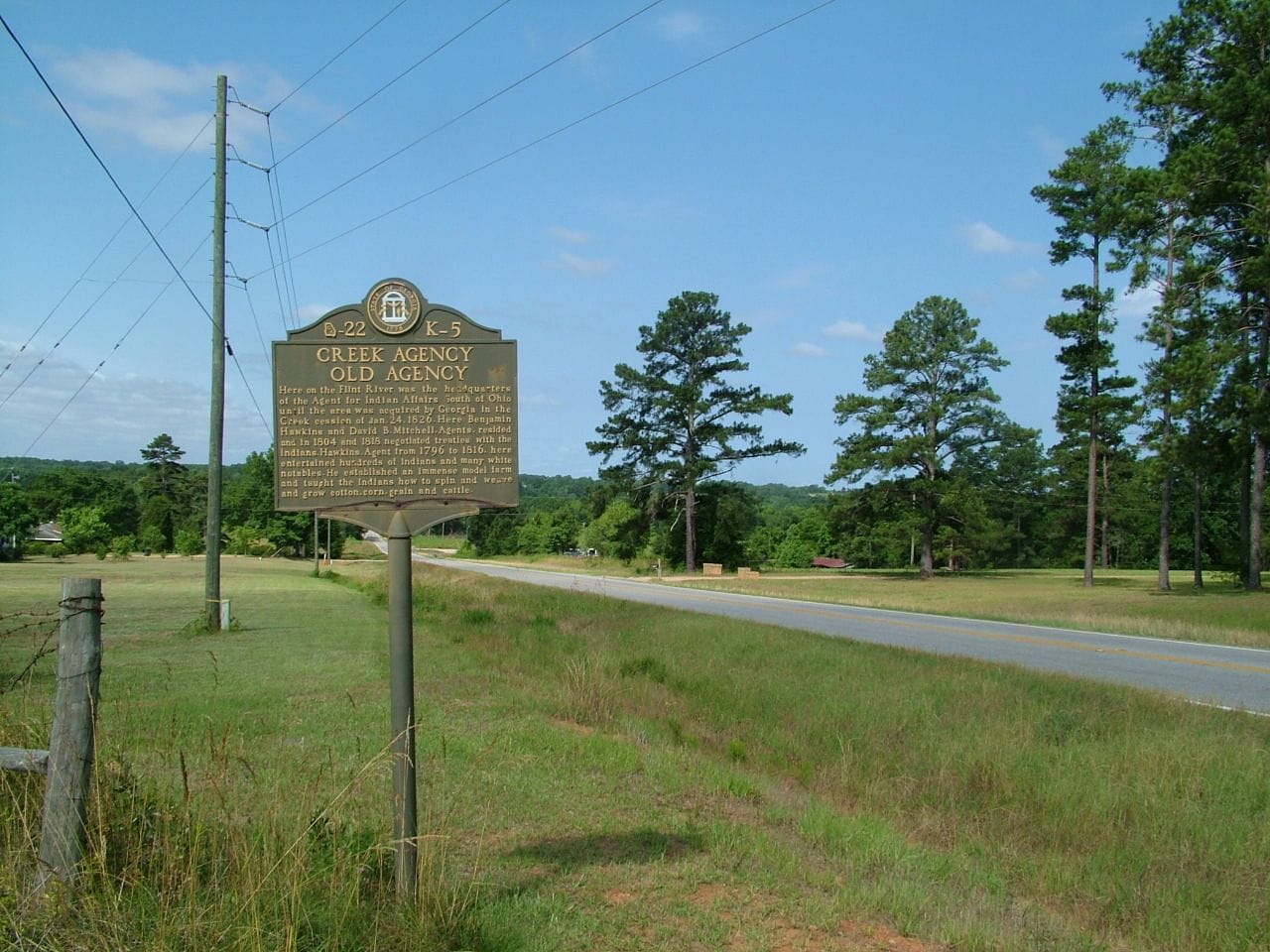
The people were held at the agency until Bowen began moving them west again, toward Alabama. He didn't make it. In January 1818 a federal revenue officer named McQueen McIntosh caught up with the coffle and seized it. Under the 1807 Act, human beings seized as illegal imports were to be delivered to the state, "to be disposed of according to law."
Disposed of according to law
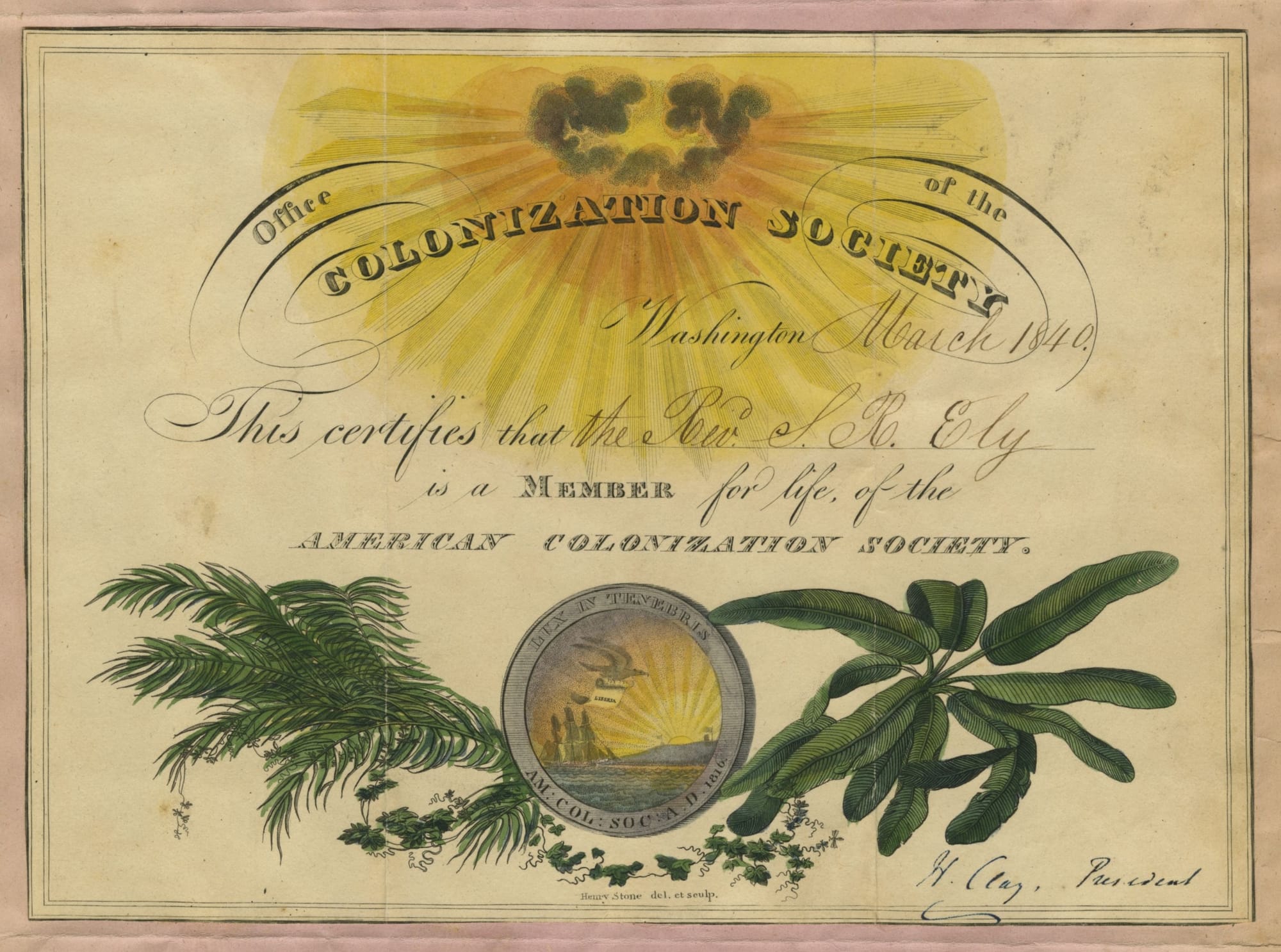
What Georgia law provided was this: the governor would seize such Africans, sell them—unless the American Colonization Society claimed them for transport to Africa—and deposit the proceeds in the treasury.
Governor William Rabun sold most of the Isabelita people into Georgia slavery. The 1823 decree puts the take at $35,000, with twenty-three persons "retained as having been demanded by the colonizing society"; later accounts put the money near $38,000 and the remainder at about thirty.
The money from the sale of the illegally imported people went into the state treasury and mixed with Georgia's general funds, where it became the thing the next decade of litigation was actually about.
The people the Colonization Society had claimed—the ones for whom the law's single narrow door to a kind of freedom stood theoretically open—waited, enslaved in the meantime, while the door swung shut. Georgia's mood turned hard against colonization during the Missouri crisis, and by the middle of the 1820s the state's political class had performed a quiet alchemy on William Bowen: the criminal smuggler became, in the retelling, a wronged property owner. In 1826 the legislature resolved the question by handing the remaining Africans back to him—restored, as it were, to their rightful thief.
So, of the 110 people taken off the Isabelita, carried from Africa in a Spanish hull, seized by Baltimore men under a Venezuelan-Mexican flag of convenience, condemned by a cardboard court, sold at Amelia Island, marched through a complicit federal agency, seized again on the road to Alabama in the name of the law that banned the trade: not one of them was freed. Not by the seizure, not by the statute, not by the courts, not by the society whose whole purpose was their supposed deliverance. The state sold most of them and kept the money; the legislature gave the rest back to the smuggler. The 1807 Act's enforcement machinery, in Georgia, functioned as a slave market with extra steps—one where the auctioneer wore a government seal and the money went straight into the governor's budget.
Three hundred holes in the sails
As for Samuel Philbrick, six months after the Isabelita, he was at sea again—same rank, new ship, new flag—and the record of that cruise is why we can call privateering his profession rather than his misadventure.
In June 1818 he sailed from Isla Margarita, off the Venezuelan coast, as Captain of Marines on the schooner Carony, a letter-of-marque commissioned by Admiral Luis Brión of the revolutionary navy—respectable enough company, this time, that she sailed in consort with a U.S. sloop-of-war carrying official dispatches. On the first of July a Spanish brig ran her down under false colors and shot her rigging, as the crew's sworn protest has it, "literally to pieces," upwards of three hundred shots through the sails. She limped into the Savannah River on the Fourth of July, where the United States, in the middle of its great post-Amelia crackdown on exactly her kind of vessel, promptly seized her: armed boats from the revenue cutter Dallas, swords out, cheering "as is the usual custom in making prize of an Enemies Vessel at Sea." The Carony's officers, saltily, noted in their protest that the cutter's own crew was caught trying to carry off the schooner's liquor in demijohns. The state suppressing piracy while helping itself to the spoils: the nineteenth century truly writes its own captions.
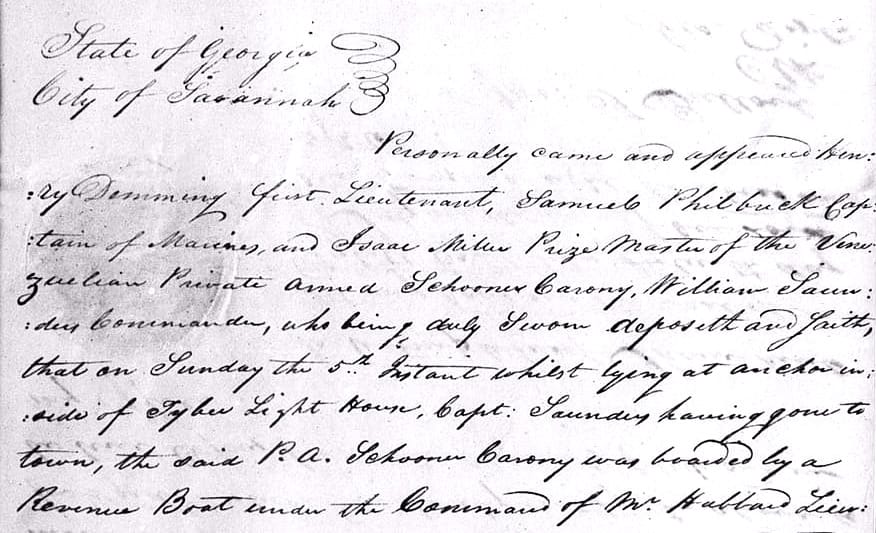
That protest was sworn in Savannah on July 11, 1818. Taken together with a February 1818 letter to his uncle John Butler, we have the earliest documents that put Samuel Philbrick ashore in the city where he would spend the rest of his life.
He stayed, and because he stayed, he was just barely eligible to draw in Georgia's 1821 land lottery, the cutoff date being Georgia residency since May 1818. While the Isabelita's people were being litigated over in the courts of the state that had sold them, a wheel turned in a lottery office and Samuel Philbrick's name came up attached to 202½ acres of just-ceded Muscogee forest near a river called Weelaunee: Lot 83, District 15, originally Henry County. He never lived on it. He probably never even saw it. What he did with it—and what he did instead, in Savannah, for thirty years—is the next installment.
Ill-gotten gains; or, "the proceeds"
The litigation over the Isabelita ground on for a decade, and it is worth following to the end, because of what it was—and wasn't—about.
Juan Madrazo wanted his property back: the ship (he got her; she was seized at Georgetown, South Carolina, and restored to him by a federal court), the surviving captives, and the money Georgia had banked. In December 1823, relying on Philbrick's deposition—the judge singled it out as making every other proof unnecessary—the federal court at Savannah found for Madrazo: the Successor had been illegally fitted out in Baltimore, her prize court was "a mock condemnation under … ephemeral Jurisdiction," and the original owner was entitled to restitution. Georgia appealed.
In 1828 the Supreme Court, in Governor of Georgia v. Madrazo, threw the whole thing out. Not on the merits, but on immunity. The suit named the governor but ran against the state, Marshall's Court held, and a state cannot be haled into federal admiralty court by a private claimant. The money stayed in Georgia's treasury. The people stayed where they had been sold.
By the time it reached the marble, the case was a Spanish slave trader suing a Southern state; the state defending its treasury; the American smuggler recast as a claimant; the United States' highest court weighing sovereign dignity, every party's property rights fully briefed and argued. The 110 appear in the caption of the case itself, with a precision the law reserved for things: sundry African slaves, and the proceeds of the same.
Nobody in a decade of filings proposed that the proceeds of a human being might be owed to the human being. That question was not before the court. It was never before any court. The violence didn't precede the property just once, at the treaty's foundational taking; the law kept re-performing the conversion—seizure after sale after decree, person into proceeds, all the way up.
Philbrick's deposition—clear, full, explicit, the best evidence in the case—served, in the end, to establish which white men had the better claim.
The privateer turns trader
The deposition of February 22, 1823, exists because Samuel Philbrick was "about to proceed beyond the limits of the United States"—the Jamaica voyage, whatever it was for. He was back within the year, trading under his own name at Market Square, on his way to becoming what the next installment will show him becoming: grocer, auctioneer, commission merchant, a founder of the seamen's mission, a resident of a house that still stands on Chippewa Square with his name on the historical marker.

In January 1823, one month before he stood in the mayor's office and swore, in that full, clear, explicit way of his, to how the Isabelita's 110 Africans had been taken and sold, Samuel Philbrick shipped a thirty-five-year-old enslaved man from Savannah to the New Orleans market on the sloop Susan. It is right there on the coastwise manifest, one line, his own name in the owner's column.
The enslaved man's name was Antonio.
The witness to the illegal trade was a working practitioner of the legal one, and the two, as the manifests in his file will show, were not different trades so much as different paperwork. That story—the people in Philbrick's ledgers, name by name, as far as the record lets me follow them—is coming soon.